

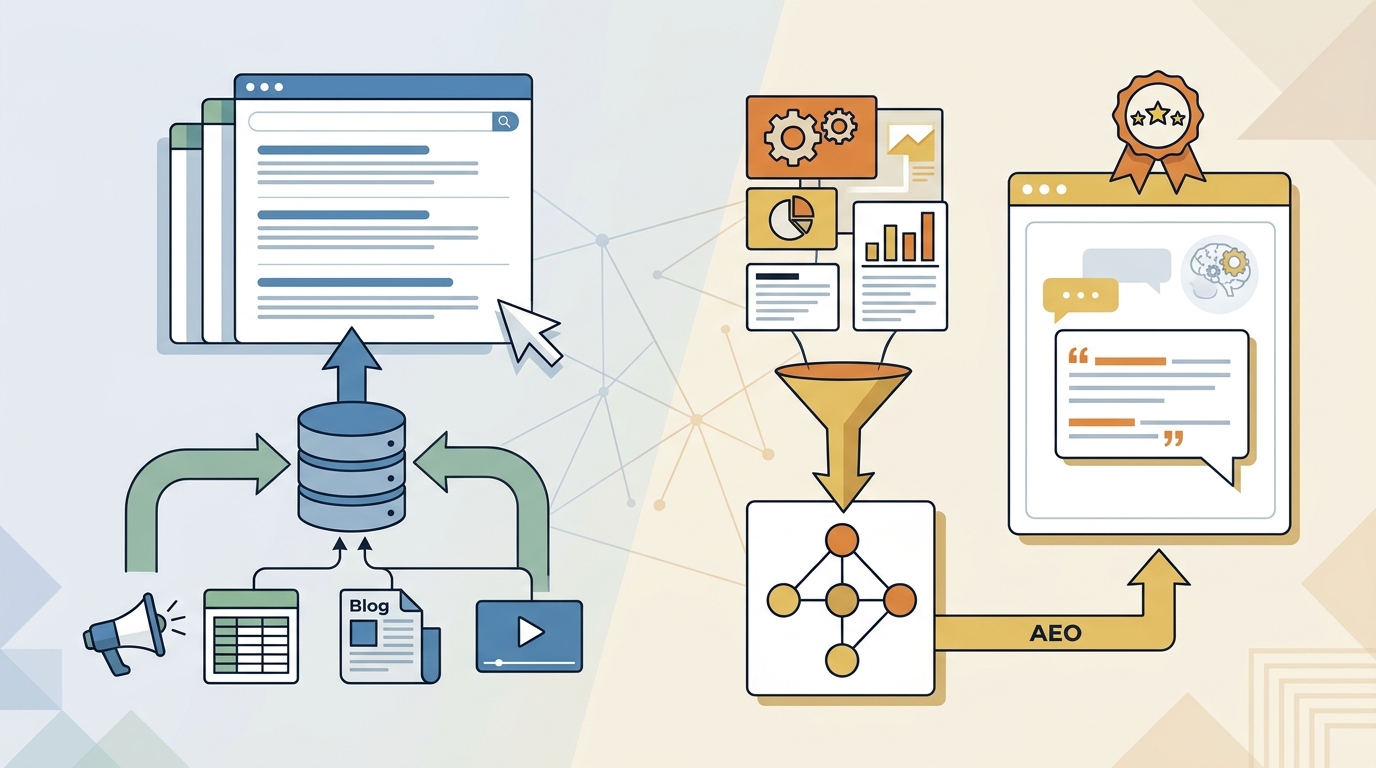
The core difference lies in the output format and user intent. Traditional SEO optimizes for ranked lists of links, while answer engine optimization (AEO) structures content to be directly cited in AI-generated summaries. For B2B brands, this shift means moving from competing for clicks to competing for citations within conversational interfaces like ChatGPT and Gemini.
Defining the Shift in Search Behavior
Search engine optimization (SEO) is the practice of improving a website's visibility in organic search results. Historically, this meant ranking high on the first page of Google to earn a click. However, user behavior is evolving. Modern B2B buyers increasingly use AI assistants to synthesize information rather than scanning ten blue links. This behavioral change forces brands to rethink how they present expertise.
Answer engine optimization (AEO) is the strategic process of structuring content so that AI models can easily extract and cite specific answers. Unlike traditional SEO, which focuses on keywords and backlinks, AEO focuses on semantic clarity and directness. When an AI model generates a response, it looks for authoritative, concise, and well-structured data points. If your content is buried in long, rambling paragraphs, the AI may skip it in favor of a competitor who provided a clear, citable definition.
This distinction is critical for B2B companies. Your goal is no longer just to be found; it is to be trusted as a source of truth. By aligning your content strategy with how AI models process information, you ensure your brand appears in the final answer the user reads.
Structural Differences in Content Architecture
The technical requirements for these two disciplines differ significantly. Traditional SEO relies heavily on keyword density, meta tags, and internal linking structures. While these elements remain important, they are no longer sufficient on their own. AEO requires a different architectural approach. Content must be modular, allowing AI systems to pull specific sections without context loss.
Consider the use of headings and subheadings. In AEO, H2 and H3 tags act as semantic anchors. They tell the AI model exactly what topic a paragraph covers. For example, a section titled "Benefits of Cloud Migration" should immediately follow with a concise list of those benefits. This direct mapping allows the AI to extract the list and attribute it to your brand. If the information is scattered across multiple, loosely connected paragraphs, the extraction process becomes less reliable.
Furthermore, AEO favors explicit definitions. When you define a term clearly, you increase the likelihood of being cited for that definition. This is where a robust content strategy becomes essential. At Goodman Lantern, we emphasize this structural clarity in our content writing services. We design content ecosystems that are not only readable for humans but also parseable for machines.
Authority and Citation in AI Models
AI models do not rank pages in the same way search engines do. Instead, they weigh sources based on perceived authority and consistency. This is where brand reputation plays a pivotal role. If multiple high-quality sources cite your data or definitions, AI models are more likely to trust and repeat that information. This creates a feedback loop where authority begets more authority.
Traditional SEO builds authority through backlinks. AEO builds authority through consistent, accurate, and well-structured information across the web. This includes your website, but also third-party publications, industry reports, and expert commentary. For B2B brands, this means investing in thought leadership. Publishing original research or unique insights gives AI models new data to cite. If you only repurpose generic industry advice, you are unlikely to be the source chosen for a specific answer.
Consistency is key. If your website says one thing and your blog says another, AI models may flag your content as unreliable. A unified brand voice and consistent messaging across all digital touchpoints strengthen your position as a trusted source. This is why strategic planning is vital. It ensures that every piece of content reinforces the same core truths about your brand and industry.
Measuring Success in a Zero-Click World
Measuring the success of AEO is different from measuring SEO. In traditional SEO, you track clicks, impressions, and rankings. In AEO, the user may never click through to your site. They read the AI-generated answer and move on. This is often called the zero-click search. How do you measure success if there are no clicks?
You measure brand mentions and citation frequency. Tools are emerging that track how often your brand is cited in AI responses. While these metrics are still evolving, they provide a clearer picture of your influence in the AI landscape. Additionally, you can monitor changes in direct traffic and brand searches. If users are seeing your brand in AI answers, they are more likely to search for you directly later in the buyer's journey.
It is also important to monitor the quality of the citations. Are you being cited for accurate, positive information? Or is the AI summarizing your content in a way that misrepresents your value proposition? Regular audits of your AI visibility can help you identify and correct any misinterpretations. This proactive approach ensures that your brand is represented accurately in the AI-generated answers that shape buyer perception.
Strategic Implementation for B2B Brands
Implementing AEO requires a shift in mindset. It is not about replacing SEO, but augmenting it. You still need strong technical SEO foundations. However, you must layer on top of that a focus on semantic clarity and directness. This means rewriting existing content to be more concise and structured. It also means creating new content that directly answers the specific questions your buyers are asking AI assistants.
Start by auditing your current content. Identify the key questions your target audience is likely to ask. Then, ensure you have a dedicated, well-structured section on your website that answers each of those questions directly. Use clear headings, bullet points, and concise definitions. This makes it easy for AI models to extract and cite your content. For more complex topics, consider creating dedicated landing pages that serve as comprehensive hubs for specific queries.
Partnering with a specialized agency can accelerate this process. Goodman Lantern specializes in creating content that is optimized for both human readers and AI systems. Our team combines deep industry expertise with technical SEO knowledge to ensure your brand is positioned for success in the AI era. We help you build a content ecosystem that is authoritative, consistent, and easily citable.
Key Takeaways
- SEO optimizes for ranked links, while AEO optimizes for direct citations in AI-generated answers.
- AEO requires modular, well-structured content with clear headings and concise definitions.
- Authority in AEO is built through consistent, accurate information across multiple sources.
- Success in AEO is measured by brand mentions and citation frequency, not just clicks.
- Zero-click search means users may not visit your site, so brand visibility in AI answers is critical.
- Strategic content planning ensures your brand is represented accurately in AI responses.
- Partnering with an expert agency can help you navigate the technical and strategic complexities of AEO.
Frequently Asked Questions
Is answer engine optimization replacing SEO?
No, AEO is not replacing SEO. It is an extension of it. You still need strong technical SEO foundations, but AEO adds a layer of semantic clarity and directness to ensure your content is citable by AI models.
How do I know if my content is optimized for AI?
Your content is optimized for AI if it is structured with clear headings, concise definitions, and modular sections. It should directly answer specific questions without requiring the reader to parse long, complex paragraphs.
What types of content work best for AEO?
Content that provides clear definitions, lists, and direct answers works best. This includes glossaries, how-to guides, and thought leadership articles that offer unique insights or data.
Do I need to change my existing content for AEO?
Yes, you should audit and update your existing content. Look for opportunities to make your content more concise, structured, and direct. This will improve its chances of being cited by AI models.
How can I measure the success of my AEO efforts?
You can measure success by tracking brand mentions in AI-generated answers, monitoring changes in direct traffic, and analyzing the quality of citations. Emerging tools can help you track your visibility across different AI platforms.
What role does brand authority play in AEO?
Brand authority is crucial. AI models are more likely to cite sources that are perceived as authoritative and consistent. Building a strong reputation through original research and consistent messaging helps you become a trusted source for AI models.