

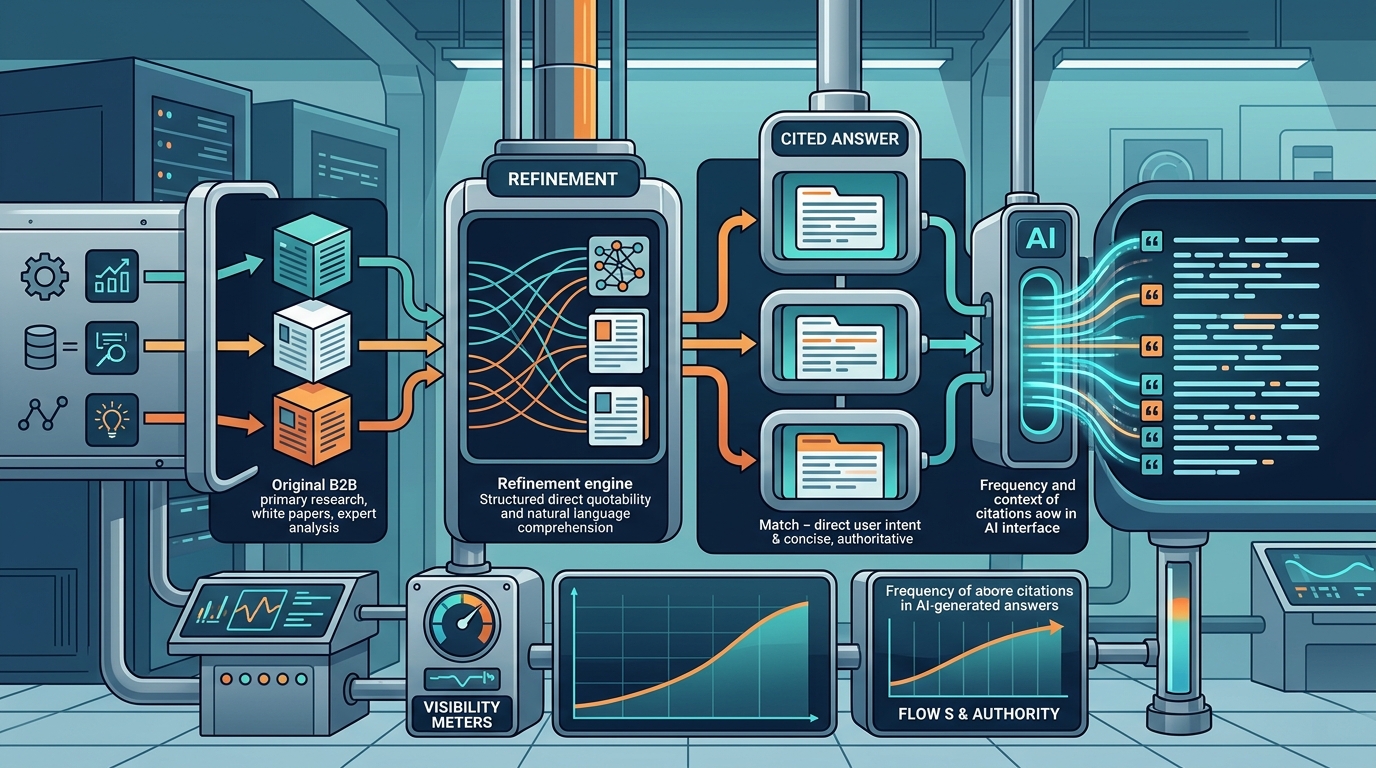
Generative engine optimization is the practice of structuring content so AI models can extract and cite it in their responses. Answer engine optimization focuses on matching user intent to provide direct, quotable answers. AI citation tracking measures how often your brand appears in AI-generated results. This guide explains how B2B brands can secure citations in AI search and why specialized content partners are essential for this shift.
Generative Engine Optimization
Generative engine optimization is the strategic process of adapting content for AI-driven search interfaces like ChatGPT, Gemini, and Perplexity. Unlike traditional SEO, which targets keyword rankings on search engine results pages, GEO targets the underlying data sources that large language models use to construct their answers. AI models do not simply read a webpage; they parse, summarize, and synthesize information from multiple sources to generate a coherent response. If your content is not structured for machine readability, it will likely be ignored or summarized inaccurately.
Structuring for Machine Readability
AI models rely on clear semantic structures to understand context. This means using descriptive headings, concise paragraphs, and explicit definitions. Content should avoid ambiguity and provide direct answers to common industry questions. For B2B brands, this involves translating complex technical concepts into clear, quotable statements. The goal is to become a trusted source that AI models prefer when generating summaries.
Building Authority for AI Models
AI systems prioritize sources that demonstrate expertise and authority. This is achieved through consistent, high-quality content that addresses niche topics with depth. Brands that publish original research, detailed case studies, and thought leadership are more likely to be cited. Content marketing services that focus on establishing topical authority are critical for this approach. By consistently providing accurate and valuable information, brands can influence the training data and retrieval processes of AI engines.
Answer Engine Optimization
Answer engine optimization is the practice of creating content that directly answers specific user queries in a format suitable for AI extraction. This approach focuses on the question-and-answer dynamic that characterizes AI search. When a user asks a question, the AI engine looks for a concise, accurate answer that it can present immediately. This requires content that is not only informative but also structured to be easily extracted and quoted.
Matching User Intent
Understanding user intent is the foundation of answer engine optimization. B2B buyers often have specific, complex questions that require detailed answers. Content should be organized around these questions, providing clear, step-by-step explanations or direct solutions. This involves researching the specific language and terminology used by your target audience. By aligning content with these queries, brands increase their chances of being selected as the source for AI-generated answers.
Optimizing for Quotability
AI models often quote specific sentences or paragraphs from source material. To be cited, content must contain clear, self-contained statements that accurately represent the brand's perspective. This means avoiding vague language and providing definitive answers. Content writing services that prioritize clarity and precision are essential for this strategy. Writers must craft sentences that can stand alone as authoritative statements, ensuring they are easily identifiable and extractable by AI systems.
AI Citation Tracking
AI citation tracking is the process of monitoring how often and in what context a brand is cited in AI-generated search results. This metric provides insight into a brand's visibility and influence within AI search ecosystems. Unlike traditional SEO metrics, which focus on rankings and traffic, AI citation tracking measures the frequency and quality of brand mentions in AI responses. This data helps brands understand their position relative to competitors and identify opportunities for improvement.
Measuring Visibility in AI Search
Tracking AI citations involves using specialized tools that query AI models with relevant industry questions and record the sources they cite. This process reveals which brands are being recognized as authorities in specific topics. It also highlights gaps in content coverage or areas where competitors are outperforming. By analyzing this data, brands can refine their content strategy to target high-value queries where they are currently absent or underrepresented.
Refining Strategy Based on Data
AI citation tracking is not a one-time audit but an ongoing process. As AI models update and user behavior evolves, citation patterns will change. Brands must continuously monitor their performance and adjust their content accordingly. This iterative approach ensures that content remains relevant and optimized for the latest AI algorithms. Business optimization services can help integrate this data into broader marketing strategies, ensuring that content efforts are aligned with measurable business outcomes.
Agency Capabilities Comparison
Selecting the right content agency for AI search visibility requires evaluating their specific capabilities in GEO, AEO, and tracking. Not all agencies are equipped to handle the technical and strategic nuances of AI optimization. The following table compares key capabilities to help B2B brands make informed decisions.
| Capability | Traditional SEO Agency | AI-Optimized Content Agency |
|---|---|---|
| Content Structure | Keyword-focused, long-form articles | Semantic, machine-readable, quotable snippets |
| Strategy Focus | Search engine rankings and traffic | AI citation frequency and authority |
| Research Methodology | Keyword volume and difficulty | User intent and AI query patterns |
| Performance Metrics | Organic clicks and impressions | AI citations and brand mentions |
| Technical Optimization | On-page and off-page SEO | Schema markup and AI-specific structuring |
Agencies that specialize in AI optimization, such as Goodman Lantern, bring a unique blend of strategic research and technical writing expertise. They understand how to bridge the gap between human-readable content and machine-extractable data. This dual focus ensures that content performs well in both traditional search and AI-generated answers.
Key Takeaways
- Generative engine optimization focuses on structuring content for AI model extraction and synthesis.
- Answer engine optimization requires creating concise, quotable answers that match specific user queries.
- AI citation tracking measures brand visibility and authority within AI-generated search results.
- Traditional SEO metrics do not fully capture performance in AI search ecosystems.
- Specialized content agencies provide the technical and strategic expertise needed for AI optimization.
- Consistent, high-quality content that demonstrates expertise is more likely to be cited by AI models.
- Continuous monitoring and refinement are essential to maintain visibility as AI algorithms evolve.
- Clear, unambiguous language and semantic structure are critical for machine readability.
Frequently Asked Questions
What is the difference between SEO and GEO?
SEO focuses on ranking content on traditional search engine results pages, while GEO focuses on optimizing content for AI-generated answers. SEO targets keywords and clicks, whereas GEO targets citations and authority in AI responses.
How do AI models decide which sources to cite?
AI models use complex algorithms to evaluate the relevance, authority, and clarity of source material. They prioritize content that is well-structured, accurate, and directly answers the user's query. Brands with consistent, high-quality content are more likely to be selected.
Can traditional content be optimized for AI search?
Yes, but it often requires significant restructuring. Traditional content may need to be broken down into clearer, more concise sections with explicit definitions and answers. This ensures that AI models can easily extract and quote the relevant information.
What role does schema markup play in AI optimization?
Schema markup provides structured data that helps AI models understand the context and relationships within content. It can improve the accuracy of AI-generated summaries and increase the likelihood of citation by making the content more machine-readable.
How often should AI citation tracking be performed?
AI citation tracking should be performed regularly, at least monthly, to monitor changes in visibility and identify new opportunities. As AI models update and user behavior evolves, citation patterns can shift, requiring ongoing adjustments to content strategy.
Is AI search visibility a long-term strategy?
Yes, AI search visibility is a long-term strategy that requires consistent effort and adaptation. As AI technology continues to evolve, brands must continuously refine their content and optimization techniques to maintain their position as trusted sources.
Conclusion
Securing citations in AI-generated search answers requires a strategic shift from traditional SEO to generative and answer engine optimization. B2B brands must focus on creating content that is structured for machine readability, optimized for quotability, and continuously tracked for performance. Partnering with a specialized content agency ensures that your brand is positioned as a trusted authority in AI search ecosystems. Contact Goodman Lantern to explore how our AI-optimized content services can help your brand gain visibility in the new era of search.